... and challenge
the Loudspeaker Industry worldwide!
At the "Reproduced Sound 2015" Conference of the
the UK Institute of Acoustics I gave a talk "The
Magic in 2-Channel Sound Reproduction - Why is it so rarely heard?"
At the ALMA International Winter Symposium in 2014 I gave
a presentation with the title "Whatever
happened to the quality of reproduced sound in the home?" and earlier I
had given a paper "My
search for the ideal stereo loudspeaker". It has been no
secret to industry insiders that little progress has been made over the last 50
years in rendering a convincing auditory illusion via two loudspeakers in a
domestic size room. Today surround sound is being pursued without having
realized the potential and perceptual realism, which 2-channel stereo is capable
of. The recording industry has of course contributed to this situation by a
multi-microphone sound pickup and pan-pot-mixing work flow. The acoustic cues
for the spatial relationship between sources and their reverberant environment
are avoided or artificially generated. Yet all naturally occurring sounds exist
in 3D space and our brain has evolved exquisitely to hear in 3D and not be
fooled.
The loudspeaker industry has developed excellent
electro-acoustic transducers over the last 50 years, but when put in boxes of
various shapes and sizes in order to send a flat on-axis signal to the listener
and illuminate the room appropriately and without spurious emissions from the
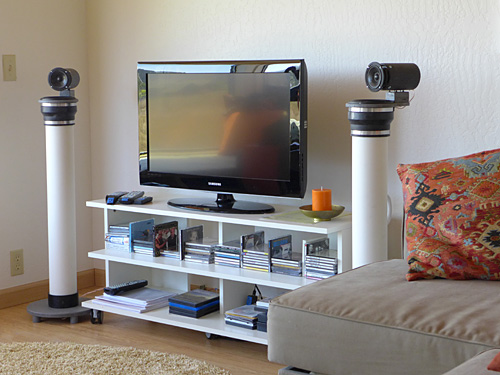
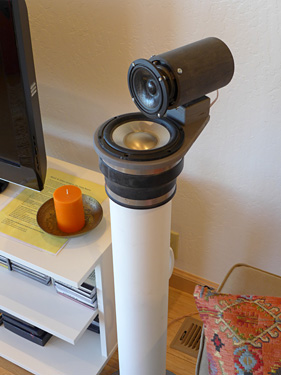
speaker, then progress has been marginal at best. The LXmini is an example of
what can be done with state-of-the-art transducers in a powered 2-way speaker
system to generate an appropriate radiation pattern. It could not be done with passive
crossover/equalization in any practical way. Using a digital signal
processor makes equalization of transducers and power division very easy, once
the acoustic design has been established for 3D radiation.
Actually, the weakness of today's speakers is primarily their acoustic design.
I do not need to name manufacturers. Exceptions are rare and insignificant in
terms of market share. For the lack of progress I would also blame equipment reviewers
of the
various audiophile magazines, because in the end they are the gate
keepers and usually beholden to the magazine's advertisers.
If each manufacturer would build a pair of LXmini's as
reference for their product development to hear in which way they exceed or miss
its performance, then real progress might be made. Each equipment reviewer
should build a pair of LXmini's as reference to compare other speakers to and to
describe in a perceptually meaningful way the differences between sound systems
as experienced in their unique and shown listening environment. Since it
is not difficult nor costly for consumers to build the LXmini as their reference, they would then
know what to expect from a loudspeaker review.
I am not saying this because I think the LXmini is the
ultimate sound quality reference, but because the LXmini defines a standard of
excellence that top of the line loudspeakers should meet or exceed and be
recognized for that by reviewers and consumers.
|